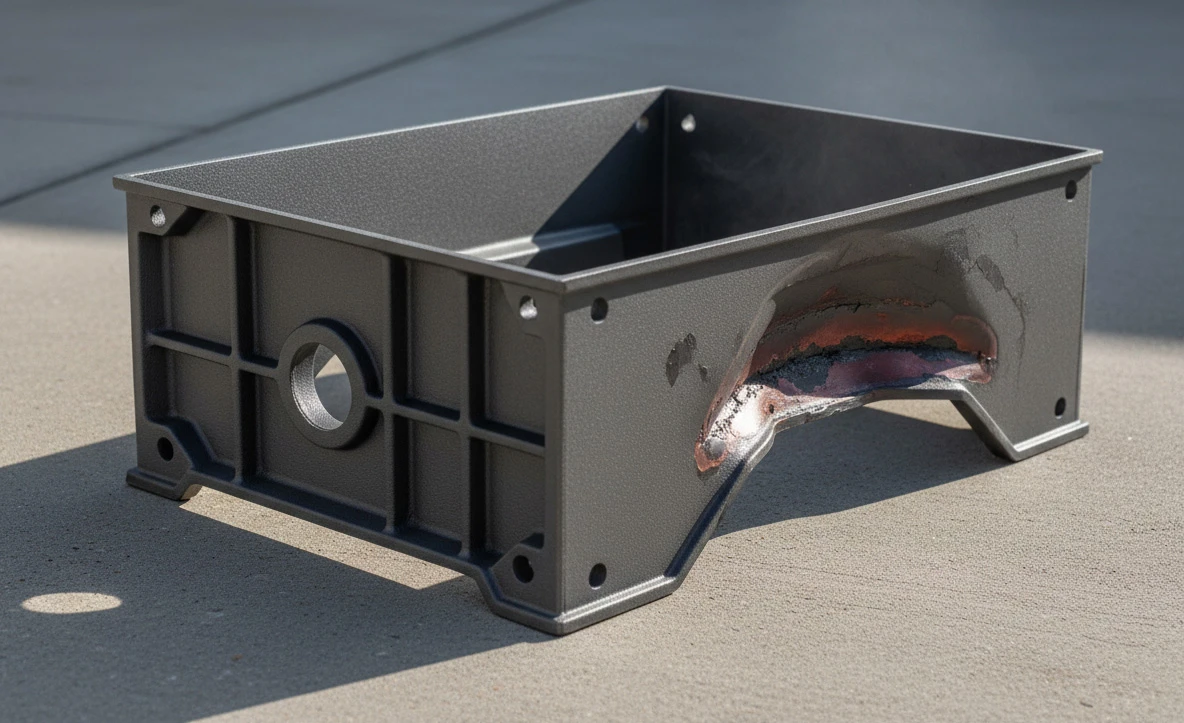
After so many years in Aluminum Die Casting, what manufacturers fear most is not rework, but a customer saying after export, “It deformed at high temperature and can’t be assembled.” Looking into this compensation case involving a peer’s exported barbecue grill to Australia with high-temperature deformation, it may look on the surface like a heat-resistance failure. But more profound investigation often reveals misaligned standards, wrong material selection, hidden process risks, insufficient structural rigidity, and even overly vague contract clauses. Below, Shine-Choose will break down the problem layer by layer.
What standards apply to the high-temperature resistance requirements of outdoor aluminum die-casting BBQ Grills?
Firstly, material selection is critical. For outdoor aluminum die-casting barbecue grills requiring high-temperature resistance, do not use ADC12, as it is prone to deformation at elevated temperatures. A380 or similar more heat-resistant alloys are recommended. During acceptance, do not look only at the melting point. The contract must clearly specify the test conditions and tolerance range in black and white (refer to ASTM B85). Australian customers commonly refer to AS 1530.4 and AS/NZS 4666; in China, GB/T 15114 and QB/T 5218 are more commonly referenced.
- Common service temperature: 200–400°C
- After short-term test conditions (such as baking at 250°C for 1 hour), the dimensional change of critical dimensions must be controlled within ±0.5 mm, hardness reduction must not exceed 10%, and there must be no blistering, cracks, or coating bubbling
What Are the Core Causes of High-Temperature Deformation in Aluminum Die-Casting BBQ Grills?
- Material formulation: Common alloys such as ADC12 have average high-temperature strength, while A380 is relatively more heat-resistant. Problems may occur during continuous use above 80°C, and local open flame exposure can more easily cause over-temperature conditions. Impurities such as excessive iron or insufficient strengthening elements will also make softening and deformation more likely.
- Structural design: If wall thickness variation is too large, ribs are too thin, or support is insufficient, uneven heating during grilling will reduce the rigidity of the aluminum die-casting barbecue grill, making collapse and warping more likely.
How Should High-Temperature Resistance of Outdoor Aluminum Die Casting Products Be Verified in Advance?
- First review the material report/TDS to confirm high-temperature performance data
- Then conduct high-temperature tensile testing, thermal cycling, and high-temperature load-holding tests to check whether deformation occurs
- Compare dimensions, hardness, and appearance before and after testing, and perform metallographic analysis if necessary
- Acceptance shall follow the standards agreed upon in the contract, such as hardness and dimensional change rate; require the supplier to provide inspection reports, and additionally carry out high-temperature bench testing in accordance with Die Casting Process-related ASTM B85 requirements (for example, testing at 180 degrees for 100 hours).
What Are the Production Process Requirements for Heat-Resistant Aluminum Die Casting Components?
| Process Stage | High-Temperature Process Requirements for Aluminum Die-Casting BBQ Grills |
|---|---|
| Material | ADC12 is commonly used under normal requirements (with attention to the risk of high-temperature deformation), while A380 or Al-Si-Cu-Mg systems are preferred for high-temperature resistance; for higher requirements, copper and magnesium may be added to improve high-temperature strength and stability. |
| Melting | The melting temperature must remain stable, with emphasis on refining and degassing to minimize porosity and oxide inclusions; otherwise, blistering and deformation will easily occur after heating. |
| Die Casting | Mold temperature is generally controlled at 200–250°C; injection should not pursue speed blindly. Start at low speed to avoid air entrapment, then ensure complete filling; vacuum die casting may be used when necessary to reduce porosity. |
| Mold | Mold cooling must be uniform to avoid local overheating; the gating and overflow system should be smooth, and local squeeze may be considered in thick sections to reduce shrinkage porosity. |
| Post-treatment | T5/T6 heat treatment can improve stability, but the improvement for standard ADC12 and A380 is limited. For higher-temperature resistance requirements, the solution should first come from the material source. |
How Should High-Temperature Resistance Clauses for Aluminum Die Casting Products Be Written into the Purchase Contract?
The purchase contract for aluminum die castings should focus on these 5 items:
- Service temperature range and duration
- Material grade + heat treatment condition
- Test items: high-temperature tensile / hardness change / dimensional deformation tests according to relevant standards and industry specifications (about ASTM B85 or QC/T 29090)
- Acceptance method: sampling inspection standard, location, and third-party report as the basis
- Liability for breach: rejection, rework, replacement, and responsibility for freight / inspection costs