For the same zinc alloy die-cast part, three Die Casting Factory suppliers may come back with three very different prices after production: RMB 9.8, RMB 16.5, and RMB 27.3 per piece. For a buyer sourcing 100,000 parts a year, the gap is not a matter of a few thousand dollars. It is a six-figure difference.
The reason is not simply profit margin. It is the cost structure. Material cost, labor cost, mold amortization, post-processing, and loss—each factory uses a different calculation method, a different baseline, and in some cases skips steps you can’t see from the quote alone. When you receive three quotations, comparing only the total price tells you very little. You need to break down how each number was built.
This article breaks down those five cost blocks and shows why each stage costs what it does, how much the premium should be, and where the padding usually hides in a quotation.
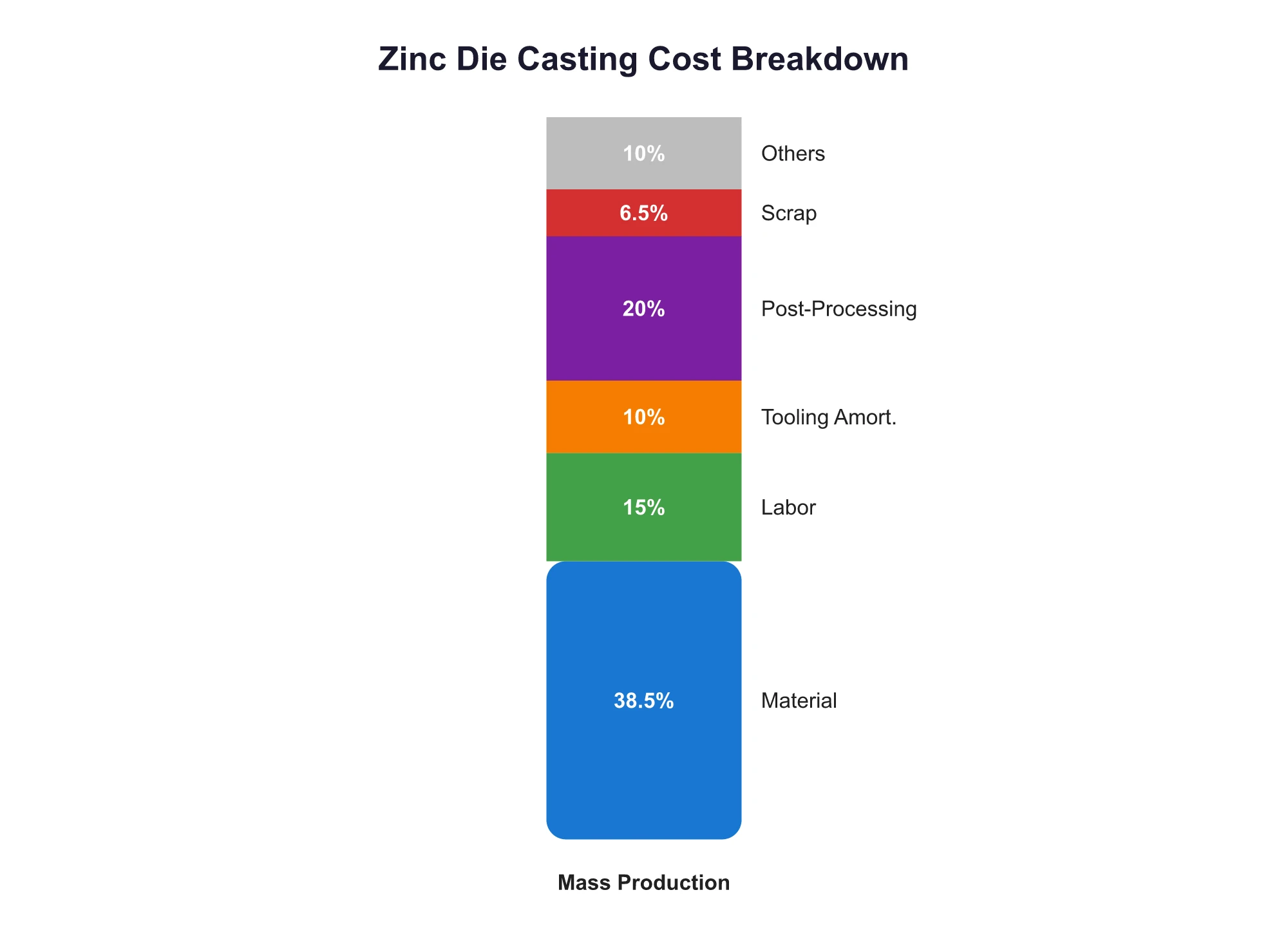
Quick reference: cost structure of zinc alloy die-cast parts
| Cost Item | Typical Share (High Volume ≥100,000 pcs) | Core Variables | Where Quotes Commonly Get Inflated |
|---|---|---|---|
| Material Cost (ZA3# Zinc Alloy) | 35-42% | Zinc ingot market price, gross weight per part, runner remelt rate | Inflated loss rate |
| Labor Cost | 12-18% | Regional wage level, automation level, yield rate | Low reported yield pushes labor cost per part higher |
| Mold Amortization | 5-15% | Mold life, total mold cost, order volume | Different volume assumptions |
| Post-Processing (Deburring + Machining + Surface Finishing) | 15-25% | Process scope, tolerance level, outsourced or in-house | One bundled price with no step-by-step breakdown |
| Loss (Non-Recoverable Scrap) | 5-8% | Process capability, mold condition | Including runners and slag bags in loss |
This structure applies to high-volume production at 100,000 pieces or more. If the order is only 5,000 pieces, mold amortization can jump to 35-60%, and the whole cost table changes order. That is the core reason the same part can be quoted at 2-3 times the price. Volume is the main variable.
Material Cost: The ZA3# Market Price Is What It Is, and the Real Difference Is Elsewhere
The most commonly used grade in Zinc Die Casting is ZA3#, or Zamak 3. It contains about 3.5-4.3% aluminum and offers good fluidity for thin-wall precision parts. In 2024, the purchase price of ZA3# in Dongguan was about RMB 22-26/kg, or about $3.26-$3.85/kg at an exchange rate of 6.75. International Zamak 3 was about $3.20/kg, equivalent to roughly RMB 21.6/kg. Prices on both sides were largely aligned.
This part of the cost is driven by the market. Any Die Casting Supplier buying zinc alloy will pay roughly the same raw material price. The real source of variation in the quote is not the unit price. It comes from two things: how the loss rate is calculated and how runner remelt is treated.
The standard industry formula is material cost = gross product weight (g) × 1.06 (loss factor) × zinc alloy unit price ÷ 1000. For a zinc alloy part with a gross weight of 150 g, the calculation is 150 × 1.06 × 24 ÷ 1000 = RMB 3.82, or about $0.57 per piece.
There is one detail that often gets buried. The 1.06 factor includes only non-recoverable loss, roughly 6%. It does not include runners and slag bags. Every die-casting cycle generates sprue and overflow material. In South China factories, these are commonly called gate scrap and flash scrap. They account for 15-30% of the shot weight, but they can be crushed and remelted, so they are not pure loss. A proper quotation includes only melt loss and scrap parts in the loss factor, typically 5-6%. A padded quotation rolls runners into the loss rate and marks it up to 8-12%. Adding 5 extra percentage points here means a hidden markup of nearly RMB 20,000, or about $2,963, on a 100,000-piece order based on RMB 3.82 per part.
When reviewing a quote, buyers should watch two things. First, check whether all three suppliers are quoting material prices in the RMB 22-26/kg range, or about $3.26-$3.85/kg. If one is far outside that range, ask what grade they are using—primary zinc or recycled zinc. Second, check the loss factor. If it is above 6%, ask one direct question: does this factor include runner remelt or not?
Mold Amortization: Why the Same Mold Can Add $0.08 or $2.37 to the Same Part
Mold amortization means spreading the total tooling cost across each part produced. The formula is simple: total mold cost ÷ expected total volume = mold cost per part. The math is simple, but if the denominator changes, the result can change by an order of magnitude.
For a standard single-cavity zinc alloy mold, the 2024 market price in Dongguan was about RMB 25,000-40,000, or about $3,704-$5,926. Typical mold life was 150,000-250,000 shots. If annual demand is 50,000 pieces, one mold is enough: 40,000 ÷ 50,000 = RMB 0.80 per part, or about $0.12. If the order is only 5,000 pieces, the same mold becomes 40,000 ÷ 5,000 = RMB 8 per part, or about $1.19. Same mold, same part, 10 times the amortized cost.
This is the practical “danger zone” for mold amortization:
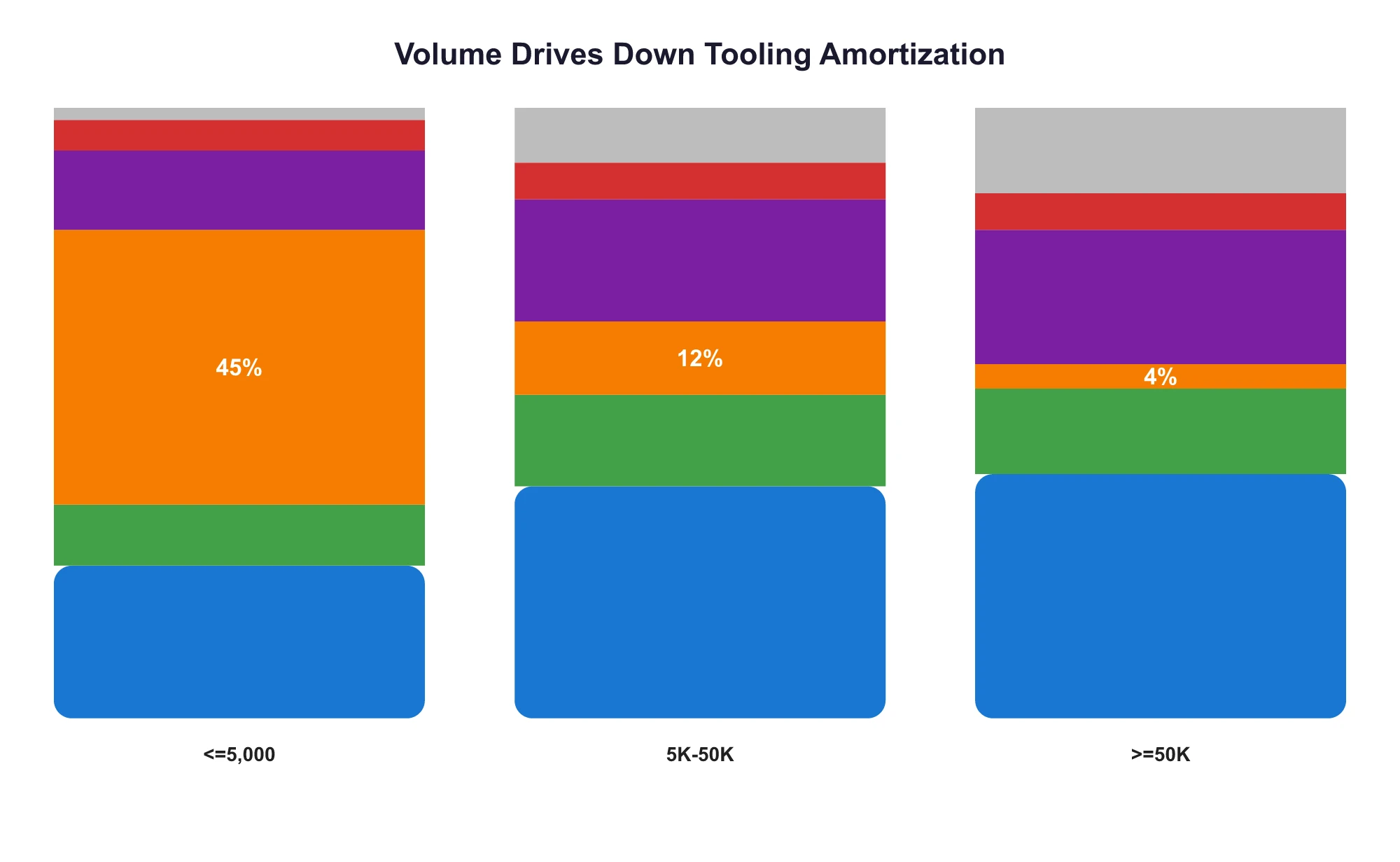
- Below 5,000 pieces: Mold amortization accounts for 35-60% of the total cost. Per-part amortization may exceed material cost. At this volume, the right move may not be pushing harder on a private mold quote. It may be evaluating whether a shared mold or a design change can work. If the mold costs RMB 40,000, that alone adds RMB 8-16 per piece, or about $1.19-$2.37, and there is only so much room to negotiate.
- From 5,000 to 50,000 pieces: Amortization drops to 8-15%. In this range, price comparison should shift from “how do we cut the mold cost” to “how do we lower post-processing unit cost and loss rate.”
- Above 50,000 pieces: Amortization falls below 3-5%. At this point, the long mold life advantage of zinc alloy tooling is fully released. When one mold runs close to the end of life, the mold cost per part becomes almost negligible.
There is a real example from the industry. One supplier promised a China-made H13 steel mold with a life of 50,000 shots. In reality, severe wear appeared at 20,000 shots, and the mold had to be replaced early. Once the cost of a second mold was spread into the program, the total was about 15% higher than choosing an imported H13 mold from the start—despite the imported option costing 30% more up front and delivering 80,000-100,000 shots of service life.
The place where mold amortization gets padded is usually not the mold price itself. Tooling prices are transparent enough to benchmark quickly. The real issue is inconsistent volume assumptions. One factory may amortize the mold across your first-year order of 5,000 pieces and show RMB 8 per part. Another may quietly assume 50,000 pieces and show RMB 0.80 per part just to make the quotation look better. When reviewing this line item, do not just read the number. Ask one question first: “What production volume did you use for this calculation?” Only when all three suppliers use the same volume basis does this item become comparable.
The Three Post-Processing Stages: Deburring, Machining, and Surface Finishing
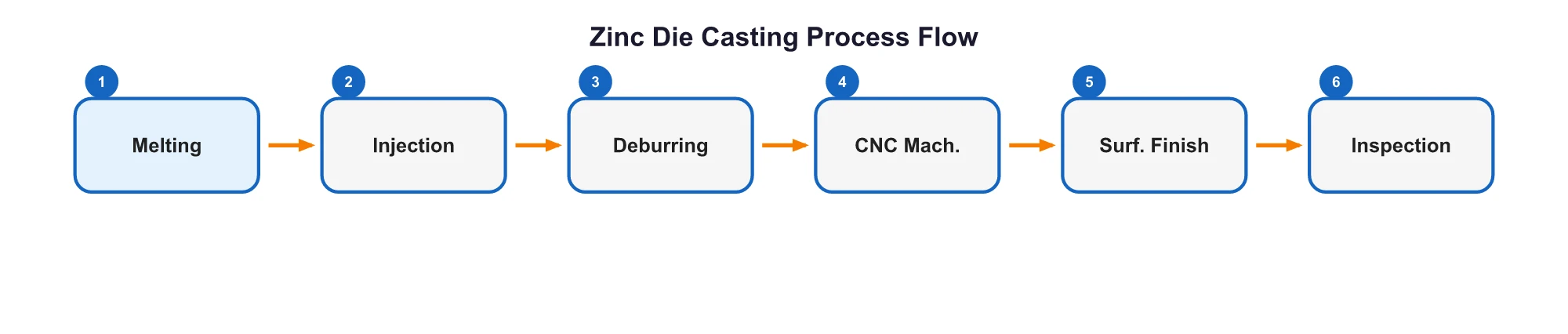
Post-processing accounts for 15-25% of total cost, and it is the line item most often buried as one vague bundled charge. It is not one process. It is three separate jobs, and each has its pricing logic.
Stage 1: Deburring, including flash removal and gate trimming. After the part comes out of the mold, flash along the parting line and excess material from the gate and runner must be removed. Manual deburring costs about RMB 0.15-0.35 per piece, or about $0.02-$0.05. At high volume, vibratory finishing can lower that to RMB 0.05-0.12 per piece, or about $0.01-$0.02.
Vibratory finishing looks cheaper, but there is a real trap. If the cycle is too long or the media is wrong, the cast surface can develop an orange-peel texture. That texture will show through after plating. There have been cases where this caused an 18% batch scrap rate. Vibratory finishing also has its own consumable cost: media at RMB 0.02-0.04 per piece, brightener at RMB 0.015-0.025, and water plus electricity at about RMB 0.005-0.008. At a monthly volume of 500,000 pieces, that becomes RMB 20,000-36,000 per month, or about $2,963-$5,333 in fixed monthly consumption.
Stage 2: Machining, including CNC drilling, tapping, and finish machining. Zinc alloy is softer than aluminum alloy and easier to machine, so CNC machine-hour cost is 30-50% lower. Typical machining cost is RMB 0.30-1.67 per piece for drilling and tapping, or about $0.04-$0.25, and RMB 1.33-5.00 per piece for finish machining, or about $0.20-$0.74. In Dongguan, CNC machine-hour rates are about RMB 35-50 per hour, or about $5.19-$7.41.
In actual production, zinc alloy has one specific machining habit: because it is soft, it tends to stick to the tool. That means TiAlN-coated tools are often needed. Residual stress from die casting can also cause dimensional spring-back after machining. The standard fix is stress-relief annealing at 120 °C for two hours. There have been cases where skipping this step led to a 12% scrap rate after machining. With annealing, that rate dropped to 2%.
Stage 3: Surface finishing. The most common finish for zinc alloy is electroplating with a copper-nickel-chrome stack. In Dongguan, typical pricing is RMB 0.40-0.65 per piece for white nickel plating, or about $0.06-$0.10; RMB 0.65-1.00 for decorative chrome, or about $0.10-$0.15; and RMB 1.20-1.80 for functional high-corrosion-resistance plating, or about $0.18-$0.27. If the process uses electrophoretic coating, the cost is about RMB 1-2.5 per piece, or about $0.15-$0.37.
One key difference matters here: plating quality is directly tied to zinc material quality. Recycled zinc carries more impurities and higher gas content. That means more subsurface gas porosity in the cast part. Once the part enters the plating bath, blistering can occur. Blister location and area are then judged under ASTM B571. With primary zinc using the ZA3# standard grade, porosity is lower, and plating yield is much better. If one supplier’s surface finishing charge is much lower than the other two, do not assume it is a bargain. Ask what zinc material they use and what inspection standard they apply before plating.
The most common way post-processing gets padded is by quoting one bundled “post-processing total” with no step-by-step breakdown. Some factories include only deburring and surface finishing, but not CNC machining because they cannot do the drilling and tapping and need to outsource it. Some include all three steps, but each step goes to a different subcontractor. Outsourcing typically adds a 15-30% markup per process. If all three stages are outsourced, that becomes a 45-90% middleman markup stacked into the final price. A factory with all processes in-house—die casting to deburring to CNC to surface finishing—eliminates that markup layer.
When reading a quotation, ask one direct question: “Can you split post-processing into three separate lines: deburring, machining, and surface finishing?” The moment you ask for that breakdown, most of the padding becomes visible.
Labor, Energy, and Loss: The Hidden Math in Small Shops and the System Math in Larger Plants
Labor accounts for 12-18% of total cost. It does not look like a major line item, but it connects directly to three common problems.
Operator wages and yield are tied together. In the Pearl River Delta, a die-casting operator typically earns RMB 6,000-8,000 per month, or about $889-$1,185. One skilled operator usually runs one to two hot-chamber machines, which are standard for zinc alloy because the plunger sits directly in the molten metal. A single shift typically produces 800-1,500 shots.
But labor cost per part is not simply wage divided by output. It also depends on yield. A factory running at 95% yield gets 950 good parts out of 1,000 shots. A factory running at 85% yield gets only 850 good parts from the same 1,000 shots. That alone creates an 11% difference in labor cost per good part. If the labor charge on one quotation is much higher than the market level, the supplier may be using a low reported yield to inflate the allocated labor cost.
If the loss rate is above 7%, ask questions. The typical loss rate in zinc alloy die casting is 5-6%, split into two parts: 2-3% melt loss from oxidation and evaporation during melting at 420-450 °C and 3-4% casting scrap caused by gas porosity, cold shut, and shrinkage. Edge trim and runners can be remelted at 100%, so they should not be counted as a loss. If a quotation shows an 8-12% loss, there is a good chance it includes the 15-30% runner fraction as well. That material can be remelted, so the buyer should not be charged for it a second time.
Energy use and production scheduling are smaller but real cost factors. Continuous production—keeping one furnace of molten zinc running without interruption—cuts energy use by about 15% versus stop-start scheduling, where one batch runs, the furnace shuts down, and then reheats for the next order. This saving shows up directly in quote competitiveness. Large factories keep schedules stable and furnaces loaded, so energy costs per part are lower. Small shops with scattered orders and frequent starts and stops usually carry higher energy costs per part.
Breaking Down Low, Mid, and High Quotes: Where Each Tier Saves Money and Where It Adds Cost
When the same part comes back with three price levels, the explanation is not as simple as “the expensive one is overpriced and the cheap one is honest.” Each price tier reflects a full-cost model and a different quality baseline. The table below aligns the differences line by line.
| Comparison Item | Low-Price Tier (20-40% Below Market Average) | Mid-Price Tier (Industry Baseline) | High-Price / Precision Tier (50-150% Above Market Average) |
|---|---|---|---|
| Mold Steel | China-made P20/H13, life 30,000-50,000 shots | Imported H13, life 80,000-100,000 shots | Upgraded H13 / 8407 with coating, life 100,000-300,000 shots |
| Zinc Material Quality | High recycled zinc ratio, higher porosity rate | Mainly primary zinc, stable composition | Primary zinc, batch-by-batch composition testing |
| Yield Rate | 85-92% | 95-98% | Above 99.5% |
| Automation Level | Mainly manual, higher labor content | Semi-automatic / fully automatic | Fully automatic plus machine vision |
| Inspection Method | Visual sampling, less than 5% | X-ray plus CMM sampling | 100% X-ray/CT inspection |
| Post-Processing | Bundled quote may include only one process | Quoted by process step | Quoted by process step and grade, all in-house |
| Loss Rate Method | May include runner remelt, quoted at 8-12% | Only non-recoverable scrap, quoted at 5-6% | Only non-recoverable scrap, tracked by batch |
| Certification | Often only business registration | ISO 9001 or IATF 16949 | IATF 16949 plus customer-specific certification |
Every line in this table answers the same question: which line item creates the price gap on the quotation?
The “cheap” part of the low-price tier usually comes from three places. The mold uses shorter-life China-made steel, often with optimistic amortization assumptions. The zinc charge contains a high recycled ratio, which raises blister risk in plating. The post-processing line may cover only one step instead of the full chain. The mid-price tier uses the cleanest logic and the most standard assumptions in each line. The high-price tier is not automatically reasonable across the board, but if the part requires zero-defect shipment—for example, an automotive safety part or a medical device housing—then 100% inspection and primary zinc are hard costs, not optional extras.
The goal of price comparison is not to pick the cheapest sheet. It is to get all three suppliers to requote using the same calculation logic. Focus on these six items:
- Is the mold cost charged separately or built into the unit price? If it is charged separately, then the unit price should not also include mold amortization.
- Can post-processing be split out? Deburring, machining, and surface finishing should be quoted separately. If a supplier cannot break it out, they may not do the work in-house or may be outsourcing part of it.
- What loss rate is shown? If it is above 7%, ask whether runner material is included.
- Primary zinc or recycled zinc? Recycled zinc may cost 15-20% less, but plating blister rates can double. The rework cost can erase the savings.
- What inspection standard and method are used? The cost gap between X-ray sampling and visual sampling is significant. Precision parts require this line to be clear.
- What is the production schedule? Expedited orders justify a surcharge because they disrupt the existing schedule. Some factories quietly build that rush premium into their standard quotation.
Once these six checks are done, the three quotations are no longer just isolated numbers like RMB 9.8, RMB 16.5, and RMB 27.3. They become three different cost models laid out on the table.
When you receive three quotations, the only meaningful way to compare them is not to see whose total is lowest. It is to break out each supplier’s five cost blocks and compare them line by line—check the material cost against the market, recalculate mold amortization using the same volume assumption, see whether the loss rate falls outside the normal industry range, and confirm exactly how many post-processing steps are included. Every line on the quote can be tested with one question: ”How was this number calculated?” If the supplier can answer clearly and the logic holds together, that is the one worth discussing further.
Price comparison is not about comparing totals. It is about comparing structural differences under the same cost model.